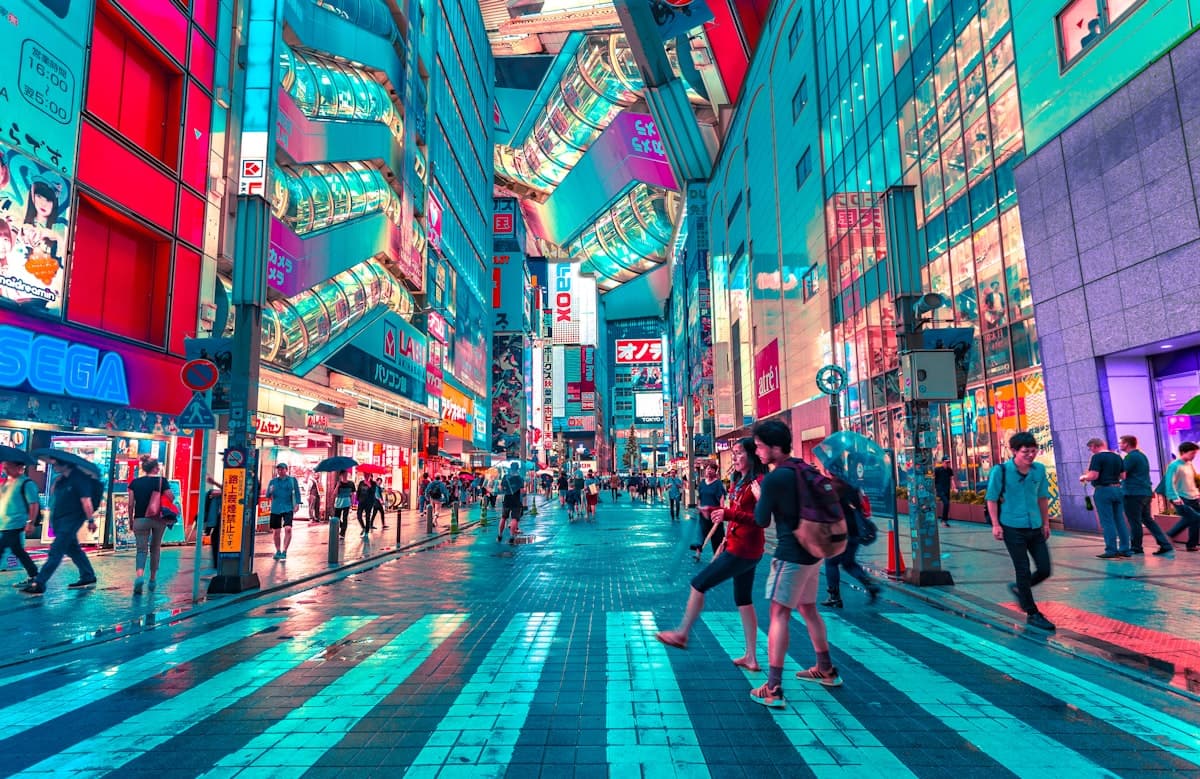
A neon-lit shopping street in Akihabara after rain, people walking over a painted crossing.
Akihabara after rainPrecision as a daily practice.
The library

Tokyo

Kantō, Japan

Twelve cities in one. Precision beside neon chaos. Meiji Shrine at dawn, a six-seat Ginza omakase at night. Shimokitazawa vintage shops. Kappabashi knife street. Trains punctual to the second, service reverent, attention to detail approaching reverence. The language barrier is gentle. The city is safe, walkable in its neighbourhoods, relentlessly new yet deeply traditional.

Best for solo find, craft pilgrims, food obsessives and design omnivores.

Craft as religion

The Tokyo principle is that a thing should be done correctly. A train within fifteen seconds of its time. A convenience-store egg sandwich better than most restaurant kitchens elsewhere. A six-seat sushi counter open for forty years because it is the best version of itself it can be.

Mediocrity is something that happens in other cities.

Inside the noise

Stand on the Shibuya scramble at sunset. Walk five minutes north into Yoyogi Park. You have not left the city; you have stepped through one of its calmer doors. Tokyo holds these contradictions in even tension.

After dark

Golden Gai is the famous version. The real evening is in the standing bars of Ebisu, the jazz kissa of Yoyogi, the unmarked whisky room above a Shimbashi yakitori counter. Nothing here requires a reservation. All of it requires knowing which door.

Moments to plan around

  • Omakase at six seats. Ginza. Two hours, no menu. The chef chooses; you decline nothing. Late evening.
  • Meiji at first light. Seventy hectares of forest before the city wakes. The torii alone. Sunrise.
  • Golden Gai by the back doors. Six bars in six alleys, each seating five. A guide ensures you walk through the right ones. After 22:00.
  • A knife at Kappabashi. An hour with a master bladesmith. A yanagiba selected for your hand. Wrapped in cloth like a gift. Daytime.

When to go

  1. January, about 10 hours of daylight
  2. February, about 11 hours of daylight
  3. March, about 12 hours of daylight, one of the best months
  4. April, about 13 hours of daylight, one of the best months
  5. May, about 14 hours of daylight, one of the best months
  6. June, about 15 hours of daylight
  7. July, about 14 hours of daylight
  8. August, about 14 hours of daylight
  9. September, about 13 hours of daylight
  10. October, about 11 hours of daylight, one of the best months
  11. November, about 10 hours of daylight, one of the best months
  12. December, about 10 hours of daylight

Late March to early April for sakura, late October through November for koyo and crisp dry weather, late May for fresh greenery and comfortable hikes. Skip July-August humidity and tsuyu rain.

Before you walk in

What to know about greetings, the table and dress before you go.

  • Don’t tip, anywhere, ever

    Tipping in Japan is genuinely confusing to receive. A waiter chasing you down the street to return your forgotten ¥500 is far more likely than them keeping it. Service is built into the bill and into the culture; trying to add to it can come across as condescending.

  • Silence on the train

    Phones go to silent mode (manner mode), eating is for shinkansen only, and standing on the left of escalators in Tokyo (right in Osaka) keeps the right side free for those in a hurry.

  • Shoes off at the genkan

    Stepping into a ryokan, a tatami restaurant, or many private homes means changing into the slippers waiting at the entrance, the genkan. There’s often a separate set for the toilet. Watch the floor for the line where the level changes; that’s the threshold.

  • Never stand chopsticks in rice

    Two chopsticks pointing up out of a rice bowl is a funeral offering. Likewise don’t pass food chopstick-to-chopstick, that’s a cremation ritual. Lay them across the rest provided, or across the bowl when you pause.

  • Carry cash, especially in older neighbourhoods

    Tokyo runs on contactless Suica/Pasmo for transport and most modern restaurants. But older sushi counters, izakayas in Golden Gai, and family-run shops are still cash-first. Pull from a 7-Eleven ATM, they accept foreign cards reliably.

  • Say: Arigato gozaimasu

    You don’t need fluent Japanese, but a sumimasen (excuse me) to get attention and arigato gozaimasu (thank you very much) when you leave a shop or restaurant will be returned with surprising warmth. It sounds like ah-ree-GAH-toh go-zai-MASS.

A starting point. Ocean can be specific about any booking on your trip.

Footnotes, by neighbourhood

Shinjuku. Depachika, department store basements. Isetan Shinjuku’s food hall is a museum of edible art. Every item is wrapped like a gift. Go 30 minutes before closing for discounted bento.

Tsukiji. Tsukiji outer market breakfast. The inner market moved, but the outer stalls are the real show. Grilled scallops at 7am. Follow the longest queue. They know something you don’t.

Yanaka. Yanaka, old Tokyo. A neighbourhood that survived the war. Wooden houses, cat statues, and a cemetery more beautiful than most gardens. The sunset staircase on Yuyake Dandan is unmissable.

Getting there

From London, about twelve hours by air.

From New York, about 14 hours by air.

From Kyoto, about two hours and a quarter by train.

Ocean plans Tokyo around the week you have in mind, with or without a trip from the edit.

Nothing is charged until the trip is confirmed. Ocean is an AI concierge. While Notturno is by invitation, a code from the house is asked for when you confirm. No invitation yet? Request one.