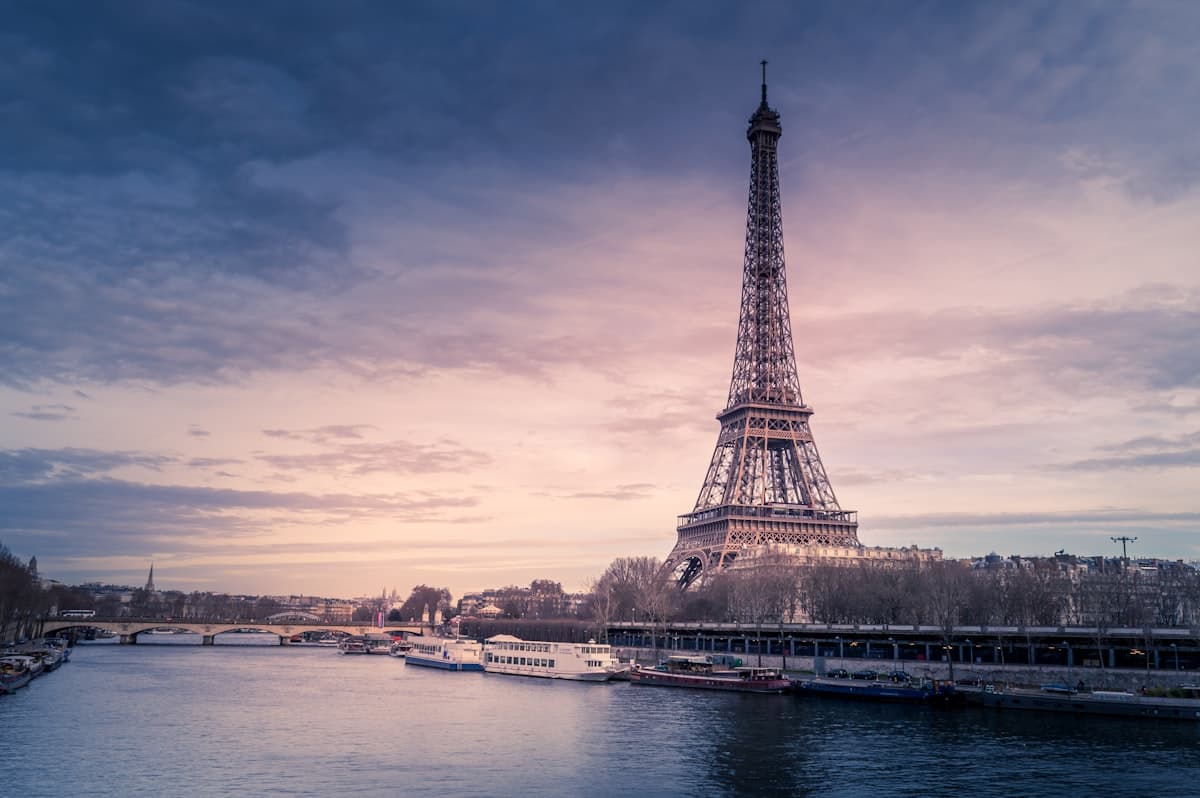
The Eiffel Tower above the Seine at dusk, river boats moored along the quay.
The Eiffel Tower above the Seine at duskAn old city, lived slowly.
The library

Paris

Île-de-France, France

Paris is best taken one quarter at a time: a morning in Saint-Germain, where the cafés on the Rue de Buci open before the shops, and an evening by the Canal Saint-Martin as the light goes. Most of what it gives is daily habit, the bakery at eight and the long lunch, and it asks for nothing but the time.

It suits an anniversary, and it suits a tenth visit by someone who wants the city without its queues.

The light

The sky over Paris is usually a soft, even grey, kind to stone and to faces. In October the sun is low enough by four in the afternoon to lay a band of gold along the Seine, and the quais between the Pont Neuf and the Pont des Arts are where to be for it.

The table

A bistro runs on its regulars. The menu is on a chalkboard, the wine comes by the carafe, and lunch is the meal that matters: most kitchens close at half past two and open again at seven. Say bonjour on the way in; nobody will bring the bill until you ask for it.

Nobody brings the bill until you ask for it, so a lunch can run on to four.

Behind the doors

Much of the Marais lives behind its carriage doors. The old hôtels particuliers around the Place des Vosges keep their courtyards, and two of them are museums you can walk into without a ticket: the Carnavalet, for the history of the city, and the Cognacq-Jay, for the eighteenth century. Along the Rue Charlot the smaller doors open on to galleries and workshops.

Moments to plan around

  • An apéritif in the Tuileries. Two of the green chairs by the octagonal basin at the Concorde end, and a bottle from a wine shop across the river. In the last hour before the gardens close, when the light is low.
  • A long lunch on the Left Bank. A corner table at a bistro in the 6th, a steak and a carafe of Côtes du Rhône, and nowhere to be before four. On a Sunday, when the city lunches late.
  • The Marais after rain. The cobbles go black and shine, the visitors go home, and the courtyard wine bars fill with the people who live there. In the evening, as the shops close.

When to go

  1. January, about 9 hours of daylight
  2. February, about 10 hours of daylight
  3. March, about 12 hours of daylight
  4. April, about 14 hours of daylight, one of the best months
  5. May, about 15 hours of daylight, one of the best months
  6. June, about 16 hours of daylight, one of the best months
  7. July, about 16 hours of daylight
  8. August, about 14 hours of daylight
  9. September, about 13 hours of daylight, one of the best months
  10. October, about 11 hours of daylight, one of the best months
  11. November, about 9 hours of daylight, one of the best months
  12. December, about 8 hours of daylight

Late April to June, and September to early November, are warm enough to eat outside and cool enough to walk all day. In August many Parisians leave for the coast, and a good number of restaurants close for the month.

Before you walk in

What to know about greetings, the table and dress before you go.

  • Say: Bonjour, madame.

    Say it to whoever is behind the counter before you ask for anything, in a shop, a café or a bakery (bohn-ZHOOR, mah-DAHM). Going straight to your question, or straight to English, reads as rude.

  • Say: L’addition, s’il vous plaît.

    The waiter will not hurry you and will not bring the bill until you ask for it (lah-dee-SYOHN, see voo PLAY). Catch an eye and nod rather than wave.

  • Service is included

    By law the price on the menu includes service. Round up, or leave a couple of euros after a good meal.

  • Dress a little above the room

    Trainers and shorts look out of place outside the summer heat. A jacket and good shoes are right everywhere from a bistro to a gallery in the 8th.

  • Say: Parlez-vous anglais?

    Ask it in French and most Parisians will answer in English (par-lay voo ahn-GLAY). A first sentence in French warms a room faster than an apology for not speaking it.

A starting point. Ocean can be specific about any booking on your trip.

Footnotes, by neighbourhood

Canal Saint-Martin. On Sundays the quais along the canal are closed to cars. Walk it from République up to Stalingrad, under the iron footbridges, and come back by the Rue de Marseille, a short street with a run of good vintage shops.

The Marais. The better wine bars here are caves à manger, wine shops with a few tables and a short list of plates. Say what you like and let the person behind the counter choose.

Saint-Germain. The bakeries open at seven, and before eight the croissants are still warm.

Getting there

From London, the Eurostar from St Pancras takes about two hours and a quarter, and a flight about an hour and twenty minutes.

From Amsterdam, the train takes about three hours and a quarter.

From New York, a direct flight from JFK takes about seven and a half hours.

Ocean plans Paris around the week you have in mind, with or without a trip from the edit.

Nothing is charged until the trip is confirmed. Ocean is an AI concierge. While Notturno is by invitation, a code from the house is asked for when you confirm. No invitation yet? Request one.