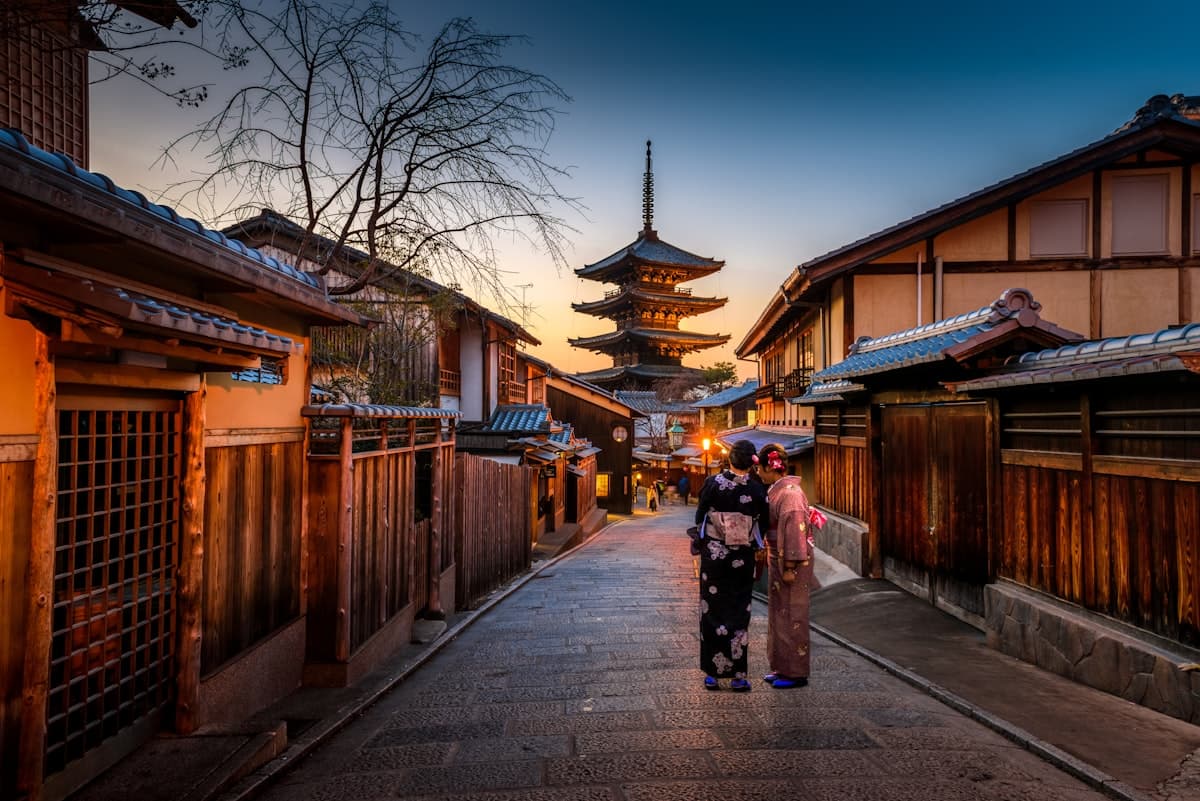
A stone-paved lane in Higashiyama at dusk, the Yasaka pagoda at its head and two women in kimono walking up.
A lane in Higashiyama at duskAn older Japan, at walking pace.
The library

Kyoto

Kansai, Japan

Japan’s ancient capital, sixteen hundred temples, four hundred shrines. Ryokan stays with tatami mornings, kaiseki dinners of a dozen tiny courses, private gardens. Glimpses of geisha in Gion at dusk. Zen rock gardens that ask nothing of you. The Philosopher’s Path. Bamboo groves in Arashiyama. Menus change weekly with the season. Ritualistic, spiritually dense. Slow mornings, long dinners, early bedtimes.

Best for slow contemplation, tea students, anniversaries and cherry-blossom pilgrims.

Seasonal religion

Kyoto’s culture is structured by season. The kaiseki menu changes weekly. Temple opening hours rotate by month. There are correct flowers for every two-week window. Travel here in late November and the koyo foliage is not decoration. It is what the city is currently for.

Time is the meal’s first ingredient.

The garden

A Kyoto temple garden is designed to slow your eye. Raked gravel. Three rocks. A single maple. Every element earns its place by being undeletable. Sit on the wooden veranda at Ryōan-ji for twenty minutes; the city’s pace recalibrates.

The old houses

The machiya, the wooden townhouses of Kyoto’s older neighbourhoods, are still lived in, restored, and converted. A night in a serious one means tatami floors, a cypress bath, and a kind of you do not encounter in any hotel.

Moments to plan around

  • A chanoyu in a machiya. Whisked matcha. Raked gravel. A host who has practiced for forty years. Ninety minutes that feel like one. Mid-morning.
  • Arashiyama at first light. The grove before the buses. Wind through ten thousand stalks. Nothing else. Sunrise.
  • Kaiseki in a ryokan. Twelve seasonal courses, each a haiku. River out the window. A robe waiting after. Long evening.
  • Fushimi Inari past the first viewpoint. Ten thousand vermillion gates climbing the mountain. Walk past the crowds; the silence sets in. Late afternoon.

When to go

  1. January, about 10 hours of daylight
  2. February, about 11 hours of daylight
  3. March, about 12 hours of daylight, one of the best months
  4. April, about 13 hours of daylight, one of the best months
  5. May, about 14 hours of daylight, one of the best months
  6. June, about 15 hours of daylight
  7. July, about 14 hours of daylight
  8. August, about 14 hours of daylight
  9. September, about 12 hours of daylight
  10. October, about 11 hours of daylight
  11. November, about 10 hours of daylight, one of the best months
  12. December, about 10 hours of daylight

Late March and early April for sakura, mid to late November for koyo, early May for shinryoku fresh greenery. Book ryokan stays far ahead for these peaks.

Before you walk in

What to know about greetings, the table and dress before you go.

  • No tipping, and especially no tipping a maiko

    Like the rest of Japan, tipping in Kyoto is unwelcome. In the pleasure quarters of Gion, attempting to tip a geiko or maiko, or trying to take a selfie with one, is treated as a serious breach. Admire from a respectful distance.

  • Bow at the torii, wash at the chozuya

    Entering a Shinto shrine: a small bow at the torii gate, a left-then-right hand wash at the stone basin (chozuya), then approach. Two bows, two claps, one bow at the offering box is the standard; a few coins (¥5 is auspicious) and a wish are the form.

  • Shoes come off, pay attention to the threshold

    At ryokan, traditional restaurants, and many temples there’s a step or a wooden frame on the floor that signals the shift from outside-shoes to slippers, then again to bare or socked feet on tatami. When in doubt, watch what the staff are wearing on each side of the line.

  • Some temples ban photographs in the inner hall

    Outside is fair game; inside the main worship halls (hondō) of certain temples, and inside Nijō Castle’s painted rooms, photography is strictly prohibited, including with phones. Look for the small sign as you enter.

  • Is the default register

    Speaking volume in Kyoto runs softer than even Tokyo. In a kaiseki room, on a bus, in a temple garden, match the room. Loud English carries unmistakably and is the fastest way to flag yourself as a tourist who hasn’t tuned in.

  • Wear the yukata, eat in your room

    At a traditional ryokan, the yukata in your room is for wearing, to dinner, to the onsen, even on a short evening walk through the lanes. Dinner usually arrives in your room or a private dining annex; tipping the staff who serve you is gently declined.

A starting point. Ocean can be specific about any booking on your trip.

Footnotes, by neighbourhood

Higashiyama. Philosopher’s Path, cherry season. A canal-side walk lined with hundreds of cherry trees. The petals fall like snow in April. Walk south to north. End at Ginkaku-ji (Silver Pavilion) for the sand garden.

Nakagyo. Nishiki market morning. Five blocks of Kyoto’s kitchen. Pickles, tofu, matcha, and knife shops. The dashimaki tamago (rolled omelette) stall halfway down is the one to find.

Getting there

From Tokyo, about two hours and a quarter by train.

From Osaka, about an hour and a quarter by air.

In this edit: Stillness.

Ocean plans Kyoto around the week you have in mind, with or without a trip from the edit.

Nothing is charged until the trip is confirmed. Ocean is an AI concierge. While Notturno is by invitation, a code from the house is asked for when you confirm. No invitation yet? Request one.